World cup memories
The team at Engramme recently put together a fantastic short video capturing what the World Cup means to different people. For some, it’s the beautiful chaos of screaming at the top of your lungs alongside thousands of strangers. For others, it’s the high-stakes anxiety of holding hands during penalty kicks, witnessing a favorite player turn a defense into Swiss cheese to score an impossible goal, or even the distinct taste and smell of an overpriced, greasy stadium hot dog dripping mustard directly onto a prized jersey.
Here is one of my favorite World Cup memories—and it comes with a heavy dose of nostalgia.
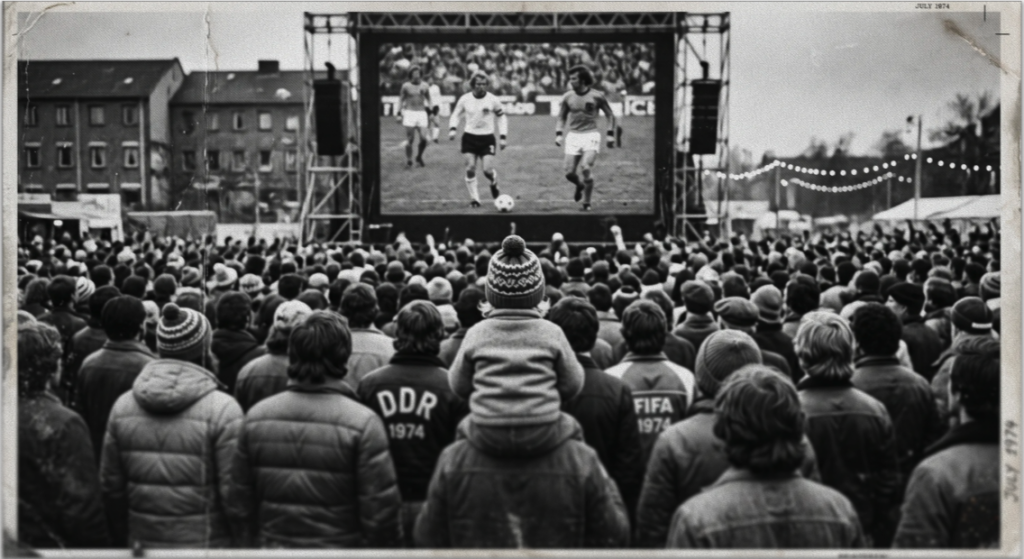
Back then, my family didn’t own a TV. In those days, the ultimate neighborhood hotspot to watch World Cup games was the sidewalk outside the local electronics shop. Picture a dozen tiny, 14-to-18-inch boxes glowing in glorious black and white—unless you lived in a wealthy neighborhood, where the lucky few got their heartbreak in technicolor.
I was six years old, standing in the middle of a dense, sweaty crowd of adults. At my diminished height, my World Cup experience consisted entirely of staring at people’s lower backs and dodging stray elbows. Sensing my impending claustrophobia, my father hoisted me onto his shoulders. Suddenly, I went from subterranean to supersonic, towering over everyone else. Looking back, I’m pretty sure my dad didn’t see a single minute of that match. He just stood there, holding up a kid who was smiling at a tiny screen from the heavens.
This trip down memory lane got me thinking: how would today’s AI retrieve these deeply human experiences?
Let’s indulge for the moment and pretend all of our personal memories have been digitized. I do appreciate that this is a strong assumption, especially when I just wrote that I was watching World Cup games in black and white outside TV shops. But the key point I want to discuss is not about recording videos of our experiences or storing conversations. These problems have already been solved.
If you ask a state-of-the-art Large Language Model (LLM) about World Cup memories, it won’t give you nostalgia. I prompted a top-tier LLM, and it confidently informed me that Lionel Messi averaged exactly 43.1 passes per game during the 2002 World Cup. I do not know if whether this a hallucination or if it is true, but that is beside the point (it was a bit suspicious when the same LLM told me that Messi was 14 years old in 2022). But let us assume that 43.1 is the correct answer. By traversing the web, you can come up with this truly amazing information.
Next, I connected the LLM to my personal email to see what “memories” it could dig up. Instead of a heartwarming blast from the past, it proudly resurfaced an old marketing promo: a “Buy Two Pizzas for the Price of One” deal, timed perfectly for the Argentina vs. Poland match in 2022. This data retrieval is entirely useless to me. It is now 2026, the game is long over, and frankly, I just ate lunch.
No, those are not the kinds of memories that we want to retrieve when we talk about the World Cup. We want the memory system of the future to bring back that moment when I was on top of my father’s shoulders, or when we prayed during penalty kicks, or the image of the hot dog mustard on our jersey.